B2B teams can now send thousands of emails and messages with the help of automation and AI.
That sounds like a major advantage.
But sending more messages does not automatically mean getting more replies, meetings, or sales opportunities.
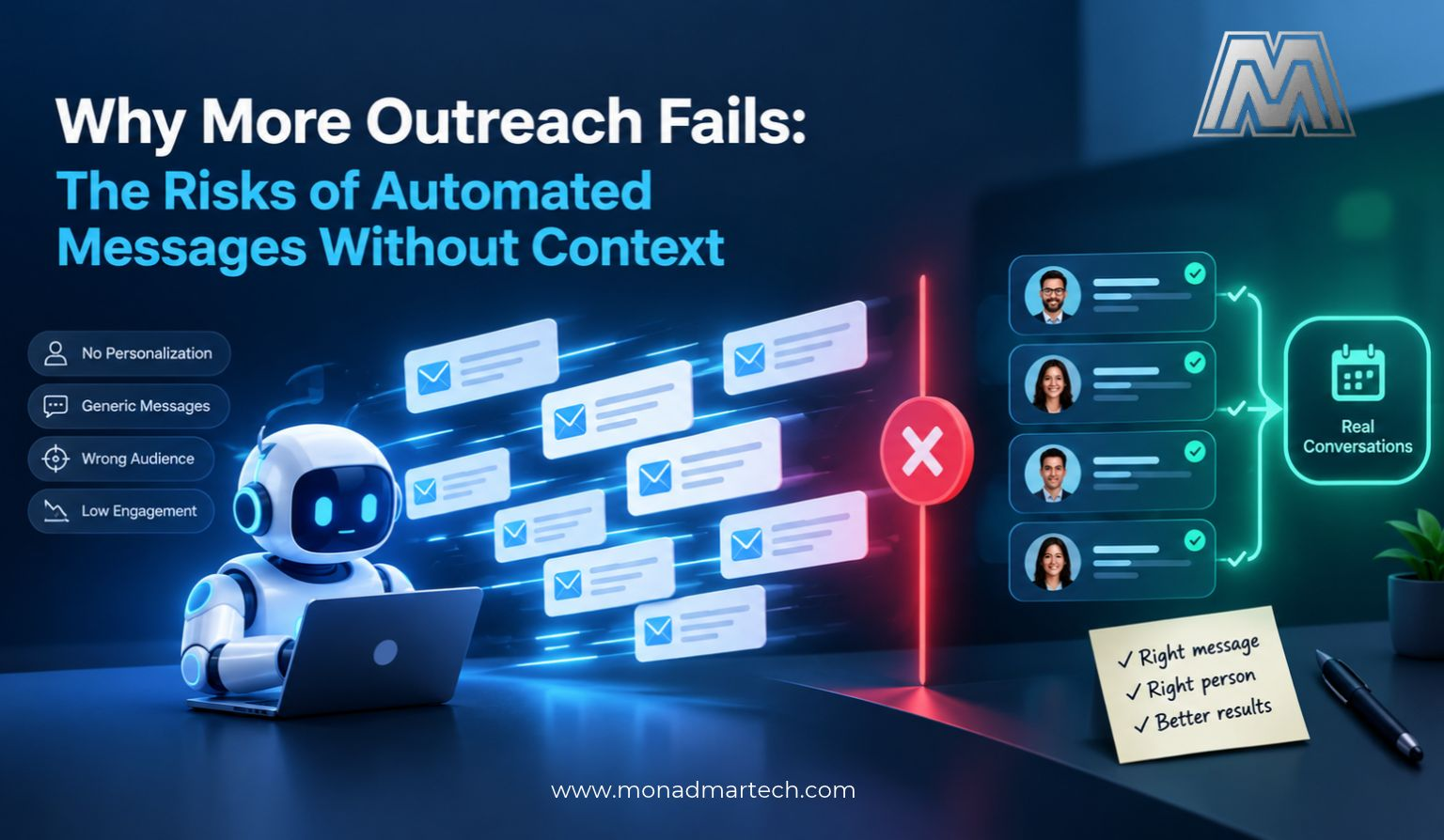
The real problem starts when automated B2B outreach focuses on volume without understanding who is receiving the message, what the company needs, or why the conversation matters.
AI can help sales teams work faster. But when it is given poor data and little context, it can also produce more generic messages at a much larger scale.
The goal should not be more outreach.
The goal should be more relevant outreach.
What Is Going Wrong With Automated B2B Outreach?
Automation is useful for repetitive tasks such as prospect research, list building, email sequencing, follow-ups, and CRM updates.
The problem comes when the same automation is used to send nearly identical messages to hundreds or thousands of prospects.
A typical message may include:
- The prospect’s first name
- Their company name
- Their job title
- A generic statement about their business
- A standard sales pitch
- An automated meeting request
Technically, the message looks personalized.
But personalization is not just adding a name.
Real personalization requires business context, buyer needs, account information, timing, and relevant signals. Current 2026 sales guidance increasingly emphasizes grounding AI outreach in account specific information and buyer context rather than shallow personalization.
Why More Outreach Can Create Worse Results?
More outreach creates more opportunities to reach prospects.
But it also creates more opportunities to send the wrong message to the wrong person.
When AI powered outreach is built around volume alone, several problems can appear.
1. Generic Messages
AI can write a professional email in seconds.
But if the input only includes a name, job title, and company, the message will usually remain generic.
For example:
“I noticed your company is growing and thought our solution could help you improve your business.”
This could be sent to almost any company.
It does not explain why the sender contacted that specific prospect.
A better message connects the outreach to something meaningful about the account.
2. Wrong Context
A prospect may work in the right industry but still have no reason to consider your service.
For example, a company may fit your target industry but:
- Already have an established solution
- Not have the problem you solve
- Be too early in the buying process
- Have no current project
- Not be the right decision maker
- Have different business priorities
Without this context, automation can turn a good prospect list into a poor outreach campaign.
3. Too Much Automation Can Remove the Human Element
Automation should reduce repetitive work.
It should not remove human judgment from the entire sales process.
AI can help identify accounts, organize data, create message drafts, and manage follow-ups. But important conversations still require understanding, judgment, and flexibility.
Modern AI enabled CRM approaches are also moving toward connecting customer data, conversations, and actionable workflows rather than simply automating messages.
4. Poor Data Leads to Poor Outreach
Your outreach is only as good as the information behind it.
If your database contains:
- Outdated job titles
- Old email addresses
- Wrong company information
- Duplicate contacts
- Missing decision makers
- Incorrect industries
- Outdated company sizes
your automation system may continue using that information without understanding that it is wrong.
This is why B2B data enrichment and regular database maintenance are important parts of a successful outreach strategy.
Better data gives AI and sales teams better information to work with.
5. More Messages Can Mean More Noise
Most decision makers already receive a large number of sales emails.
Sending another generic message does not necessarily create attention.
The message needs a reason to matter.
Instead of asking:
“How many emails can we send?”
B2B teams should ask:
“How many relevant conversations can we create?”
That change in thinking can completely change an automated B2B outreach strategy.
What Context Should AI Have Before Sending a Message?
AI should not create outreach based on contact information alone.
A stronger system should consider several layers of information.
Account Context
Understand the company before contacting someone.
Look at:
- Industry
- Company size
- Location
- Business model
- Products or services
- Growth stage
- Technology environment
Buyer Context
Understand the person receiving the message.
Consider:
- Job role
- Department
- Responsibilities
- Seniority
- Possible business priorities
- Relationship with the buying process
Business Context
Ask why this company may need your service.
For example:
- Are they expanding?
- Are they hiring?
- Are they entering a new market?
- Are they launching a new product?
- Are they facing a problem your service can solve?
Intent Context
Look for relevant signals that suggest an account may have an active need.
This can include:
- Website engagement
- Content engagement
- Research activity
- Technology changes
- Hiring activity
- Business announcements
- Previous interactions
This is where intent based outreach becomes more useful than simply sending messages to a large contact database.
How to Build Better AI Email Outreach
AI does not need to be removed from your sales process.
It needs better inputs.
A practical AI email outreach process can follow these steps.
Step 1: Define Your Ideal Customer
Before creating an outreach sequence, clearly define your ideal customer profile.
Identify:
- Target industries
- Company size
- Locations
- Relevant job roles
- Business challenges
- Buying triggers
This prevents automation from targeting everyone.
Step 2: Clean Your B2B Data
Review your database before starting the campaign.
Remove duplicate and outdated records.
Enrich missing information.
Verify important contact and company details.
This creates a stronger foundation for B2B lead generation.
Step 3: Add Relevant Signals
Do not rely only on basic firmographic information.
Add useful business signals wherever possible.
The objective is to understand:
Who is the prospect?
Why does the account fit?
Why contact them now?
What problem could we realistically help solve?
Step 4: Create Context Based Messages
Instead of creating one message for everyone, create messaging based on different situations.
For example:
Technology company hiring heavily:
Focus on growth, scale, and potential operational challenges.
Manufacturing company entering a new market:
Focus on market coverage and reaching relevant business contacts.
SaaS company expanding sales:
Focus on pipeline development and targeted B2B opportunities.
The message changes because the context changes.
Step 5: Use AI as a Support System
AI can help with:
- Research summaries
- Message drafts
- Personalization
- Follow-up suggestions
- Lead prioritization
- CRM updates
- Campaign analysis
But important messages should still have human oversight.
The goal is not to make outreach completely automated.
The goal is to make your sales team faster without making your communication less relevant.
Automated Outreach vs. Context Based Outreach
| Automated Outreach | Context Based Outreach |
|---|---|
| Focuses on volume | Focuses on relevance |
| Same message for many prospects | Messaging changes based on account context |
| Uses basic contact data | Uses account and buyer signals |
| Measures activity | Measures conversations and opportunities |
| Heavy automation | Automation + human judgment |
| More messages | Better targeted messages |
The difference is simple.
Automation tells you how to send more messages.
Context tells you who to message, what to say, and when to say it.
How This Can Improve B2B Appointment Generation?
The purpose of outreach should not be to fill an activity dashboard.
It should be to create meaningful conversations.
A better process can move through:
Right Account → Right Contact → Right Context → Right Message → Right Timing → Sales Conversation
This approach can support stronger B2B appointment generation because the outreach is connected to an actual business reason.
It also gives sales teams a clearer reason to follow up.
The Future of B2B Sales Outreach
AI will continue to play a bigger role in sales.
But the advantage will not simply come from sending more messages.
As AI makes it easier for companies to create and distribute outreach, relevance becomes more important.
Businesses will need better:
- B2B data
- Account intelligence
- Buyer signals
- Personalization
- Campaign strategy
- Human oversight
- Sales and marketing alignment
The strongest B2B sales automation strategies will combine technology with good data and clear business context.
Final Thoughts
More outreach does not always create more sales.
When automated messages are sent without enough context, businesses can end up with generic communication, poor engagement, wasted sales activity, and missed opportunities.
AI is not the problem.
Using AI without the right data, context, and strategy is the problem.
A better approach is to automate the repetitive work while keeping the important decisions focused on relevance.
At Monad MarTech, we combine B2B data, targeted lead generation, personalized outreach, demand generation, and appointment generation to help businesses reach the right prospects with more relevant messaging. As an advanced B2B marketing company in India and USA, we focus on creating targeted strategies that support measurable business growth.
The goal is not to send more messages. The goal is to create better conversations.