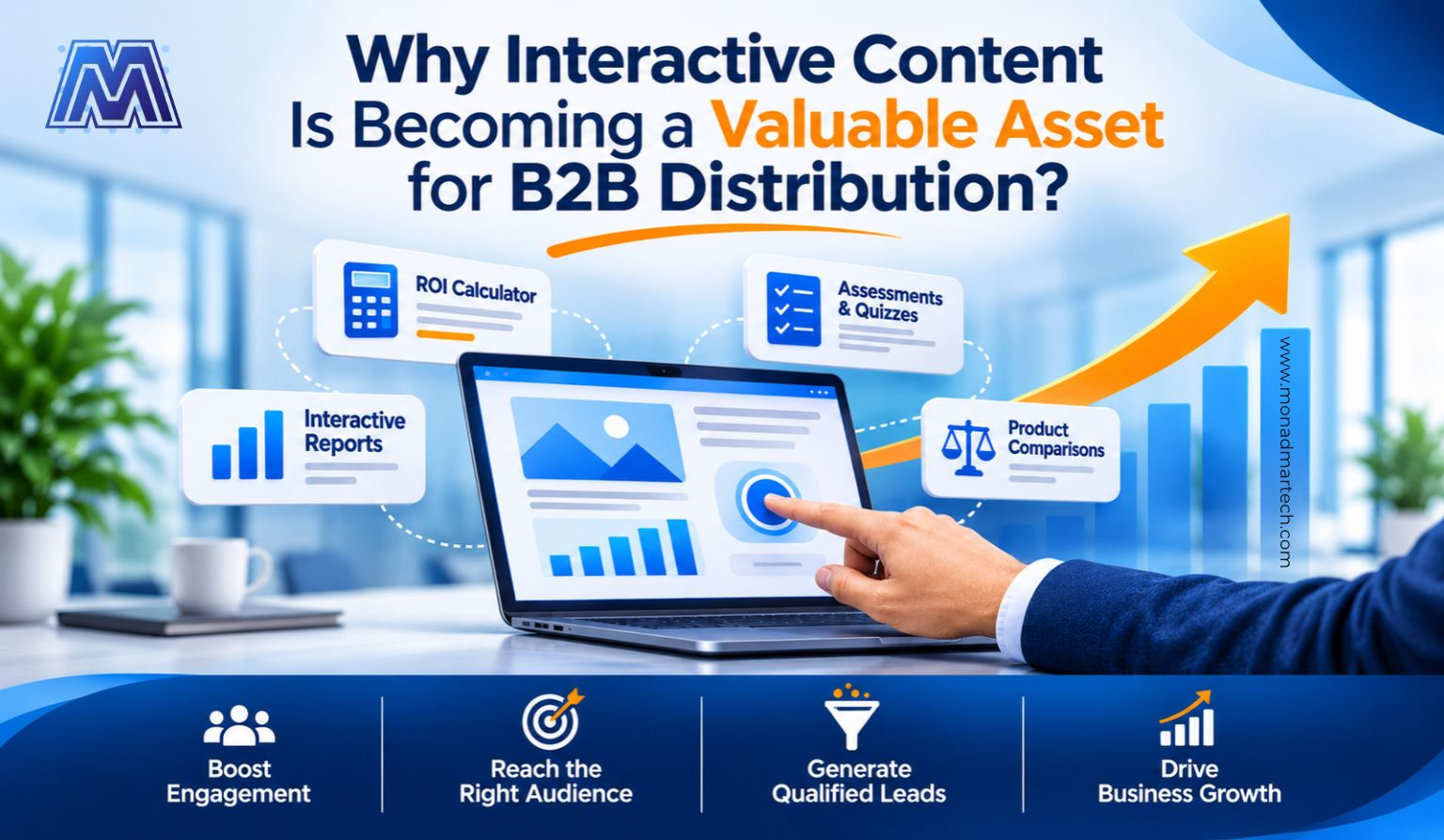
B2B buyers have more information available than ever before. They read industry reports, compare solutions, review case studies, attend webinars, and research potential suppliers before speaking with a sales team. With so much content competing for their attention, simply publishing an article or sharing a downloadable guide may not be enough to create meaningful engagement.
This is where interactive content for B2B marketing is gaining importance. Instead of only asking prospects to read or download information, interactive content encourages them to take part in the experience. They can answer questions, assess their business needs, calculate potential results, compare options, or explore information based on their interests.
For B2B companies, this creates new opportunities to distribute useful content, understand audience preferences, and generate more relevant engagement. When supported by a well-planned B2B content distribution strategy, interactive assets can help businesses connect content engagement with lead generation and demand generation.
What Is Interactive Content in B2B Marketing?
Interactive content is any digital content that requires or encourages an audience to actively participate rather than simply consume information.
Traditional content usually presents information in a fixed format. Interactive content gives users an opportunity to engage with that information through actions such as selecting answers, entering details, exploring data, or receiving personalised results.
Common examples of interactive content used in B2B marketing include:
- Assessments and quizzes: Help prospects evaluate their current business processes, challenges, or readiness.
- ROI calculators: Allow buyers to estimate potential savings, returns, or business impact.
- Interactive reports: Present research findings through clickable charts, filters, and data visualisations.
- Product configurators: Help prospects compare features and identify solutions that match their requirements.
- Decision-making tools: Guide users through questions to help them evaluate available options.
- Interactive infographics: Present complex information in a format that users can explore.
- Online assessments: Help businesses identify gaps in areas such as cybersecurity, marketing performance, or operational efficiency.
For example, a SaaS company could create an ROI calculator that allows potential customers to estimate how much time or money they might save by using its platform. A manufacturing technology provider could develop an assessment that helps companies review their production efficiency.
Both formats provide useful information while giving the business a better understanding of what its audience is interested in.
Why Is Interactive Content Becoming Valuable for B2B Distribution?
B2B content distribution is no longer just about making content available across different channels. Businesses also need to give their target audiences a reason to engage with it.
Interactive content supports this goal in several ways.
1. It Encourages Active Audience Engagement
A standard article or downloadable PDF gives readers information, but it does not always encourage them to participate. Interactive content creates a two-way experience.
When prospects use a calculator, complete an assessment, or explore an interactive report, they become active participants. This can make the content more relevant to their business needs and encourage them to spend more time engaging with it.
For B2B marketers, this creates an opportunity to make content distribution more meaningful. Instead of focusing only on how many people viewed an asset, marketers can also consider how audiences interacted with it.
2. It Helps Businesses Understand Buyer Interests
Every interaction can provide useful context about a prospect’s interests.
For example:
- A user completing a cybersecurity assessment may be interested in identifying security gaps.
- A prospect using a cost calculator may be evaluating operational expenses.
- Someone exploring a product comparison may be reviewing potential solutions.
- A visitor filtering an industry report may be researching a specific market segment.
These interactions can help marketers understand which topics and challenges matter to their audiences.
However, engagement should not automatically be treated as buying intent. A person using a calculator may simply be researching. Businesses should combine interaction data with other relevant signals, such as company fit, role, industry, and follow-up activity, before deciding how to prioritise a prospect.
3. It Makes Complex B2B Information Easier to Understand
B2B products and services can involve technical details, multiple features, financial considerations, and lengthy decision-making processes.
Explaining everything through long-form content may not always be effective. Interactive formats can make complex information easier to explore.
For example, an interactive comparison tool can help buyers understand the differences between two solutions. A data visualisation can make industry research easier to interpret. An ROI calculator can help a decision-maker connect product benefits with business outcomes.
This is particularly useful for companies operating in IT, SaaS, manufacturing, and other industries where buyers need detailed information before making decisions.
4. It Supports Personalised Content Experiences
Different people within a B2B buying group often have different priorities.
A finance leader may focus on cost and return on investment. An IT decision-maker may want to understand security, integration, and technical requirements. A department head may be more interested in productivity and operational impact.
Interactive content can respond to these different interests.
For example, a business assessment can provide different recommendations based on the answers selected by a user. An interactive report can allow readers to filter information by industry, company size, or business challenge.
This makes content distribution more relevant because prospects can focus on the information that matters to them.
5. It Creates More Opportunities for Lead Generation
Interactive content can support B2B lead generation when it offers genuine value to the audience.
A company might provide an industry benchmark report, assessment, or personalised results in exchange for selected business details. The information collected can help the marketing team understand who engaged with the content.
However, lead generation should not depend only on collecting form submissions. Businesses should also consider whether the prospect matches their target audience, whether the information is accurate, and whether the interaction indicates a relevant business need.
A useful interactive asset can therefore support lead generation while improving the context available to sales and marketing teams.
6. It Gives Existing Content More Distribution Potential
Businesses do not always need to create new content from the beginning. Existing reports, whitepapers, blogs, and research can be adapted into interactive experiences.
For example:
- A research report can become an interactive data dashboard.
- A whitepaper can be converted into a business assessment.
- A long-form blog can inspire a checklist or calculator.
- A case study can become an interactive results comparison.
- An industry report can be presented through clickable charts.
This approach helps businesses extend the value of their existing content assets and distribute information in formats that appeal to different audiences.
Interactive Content vs. Traditional B2B Content
Both traditional and interactive content have an important role in B2B marketing. The right choice depends on the topic, audience, and campaign objective.
| Area | Traditional content | Interactive content |
|---|---|---|
| Audience experience | Mainly reading or viewing | Active participation |
| Information delivery | Fixed format | Can adapt to user input |
| Engagement | Often measured through views and downloads | Can include clicks, answers, selections, and tool usage |
| Personalisation | Usually based on the content selected | Can respond to user preferences |
| Data insights | Often limited to page and download activity | Can provide additional interaction context |
| Examples | Blogs, PDFs, whitepapers | Calculators, assessments, interactive reports |
Traditional content remains valuable for explaining ideas, building authority, and supporting organic search visibility. Interactive content adds another layer by allowing prospects to engage with the information.
A strong B2B content distribution strategy can use both formats together instead of treating them as competing approaches.
How to Use Interactive Content in a B2B Content Distribution Strategy?
Creating an interactive asset is only one part of the process. Businesses also need a clear distribution plan to reach the right audience and turn engagement into useful marketing opportunities.
Step 1: Identify Your Target Audience
Start by defining the companies and decision-makers you want to reach.
Consider:
- Target industries
- Company size
- Geographic markets
- Job titles and decision-making roles
- Business challenges
- Technology or service requirements
A calculator designed for manufacturing operations leaders, for example, may not be relevant to a SaaS finance team. Audience research helps ensure that the interactive experience matches the needs of the intended users.
Step 2: Select the Right Interactive Format
Choose a format based on what your audience needs to understand or evaluate.
| Marketing objective | Suitable interactive format |
|---|---|
| Help buyers understand business challenges | Assessment or quiz |
| Demonstrate financial value | ROI calculator |
| Present research findings | Interactive report |
| Compare products or services | Comparison tool |
| Explain a complex process | Interactive infographic |
| Help prospects evaluate readiness | Readiness assessment |
The format should make the information easier to use. Adding interaction without a clear purpose can make the experience unnecessarily complicated.
Step 3: Create Content That Solves a Specific Problem
The content should offer practical value instead of focusing only on promoting a product or service.
For example, an IT service provider could create a cloud-readiness assessment. A SaaS business could offer a software cost calculator. A manufacturing company could develop an operational efficiency assessment.
When the content addresses a real business challenge, it gives the audience a stronger reason to engage.
Step 4: Distribute It Through Relevant Channels
Once the asset is ready, promote it through channels where your target audience is likely to find it.
These may include:
- Content syndication: Distribute the asset through relevant third-party publishers and industry-focused platforms.
- Email marketing: Share the interactive experience with relevant contacts and segmented audiences.
- LinkedIn marketing: Promote the asset through company pages, employee networks, and relevant professional communities.
- Website and landing pages: Feature interactive tools on relevant service pages, resource hubs, and campaign landing pages.
- Paid B2B campaigns: Use targeted advertising to reach selected industries, companies, and decision-makers.
- Sales outreach: Share relevant interactive resources with prospects as part of personalised communication.
The key is to select distribution channels based on audience relevance, not simply the number of channels available.
Step 5: Connect Engagement With Lead Nurturing
After a prospect interacts with the content, the next step should be relevant follow-up.
For example, someone who completes a business assessment could receive a follow-up email containing related insights. A prospect who uses an ROI calculator may be interested in a case study explaining how a similar business addressed the same challenge.
Marketing teams can use these interactions to segment audiences and plan relevant communication. Sales teams can also use the available context when a prospect is ready for a conversation.
Follow-up should respect the user’s consent and communication preferences.
Step 6: Measure Performance and Improve the Experience
Track more than the number of views or downloads. Consider metrics that show how people use the content and whether it contributes to business outcomes.
Useful metrics include:
- Content impressions and visits
- Interaction or completion rate
- Calculator and assessment usage
- Form completion rate
- Qualified leads generated
- Cost per qualified lead
- Email engagement after interaction
- Meetings or sales opportunities influenced
- Conversion rates across campaign stages
Review these results regularly. If users visit an interactive tool but do not complete it, the experience may need simpler questions, clearer instructions, or a more relevant offer.
How Content Syndication Can Expand the Reach of Interactive Content?
Content syndication helps businesses distribute their content beyond their own websites and existing audiences. When used strategically, it can introduce interactive assets to relevant prospects who may not otherwise come across the brand.
For example, a B2B technology company could distribute an interactive IT assessment through publishers that reach technology decision-makers. A manufacturing solutions provider could promote an operational efficiency calculator through industry-focused media platforms.
However, successful distribution depends on more than generating traffic.
Businesses should evaluate:
- Whether the publisher reaches the intended industry and audience
- Whether the audience matches the ideal customer profile
- Whether the content topic is relevant to the publisher’s readers
- Whether lead information is collected transparently and accurately
- Whether campaign results can be measured beyond initial engagement
Interactive content can make a syndicated campaign more engaging, while content syndication can help that asset reach a broader and more relevant audience.
The two approaches work best when they are connected to a clear lead nurturing and follow-up process.
Common Mistakes to Avoid When Using Interactive Content
Interactive content can support B2B marketing, but a poorly planned experience may create more friction than value.
Avoid these common mistakes:
1. Adding interaction without a clear purpose
A quiz or calculator should help users answer a question or solve a problem. Interaction alone does not make content useful.
2. Asking for too much information
Long forms can discourage users from completing an assessment or accessing results. Collect only the information needed for the campaign objective.
3. Ignoring mobile users
Interactive tools should work smoothly on mobile devices as well as desktops. Difficult navigation or slow loading can reduce engagement.
4. Treating every interaction as buying intent
A completed assessment or calculator session does not necessarily mean a prospect is ready to purchase. Evaluate engagement alongside company fit and other relevant signals.
5. Distributing content to the wrong audience
Even a well-designed tool may produce poor results if it reaches people outside the target market. Use audience and publisher selection carefully.
6. Failing to plan the next step
Content engagement should connect to a relevant follow-up experience. Without a clear nurturing process, valuable interactions may not lead to meaningful business conversations.
How to Measure the ROI of Interactive Content?
To understand whether interactive content is delivering value, businesses should connect engagement metrics with lead quality and campaign outcomes.
A simple measurement framework can include three stages:
Engagement: How many people accessed and interacted with the asset? Review visits, interaction rates, completion rates, and time spent using the tool.
Lead quality: Did the campaign attract relevant companies and decision-makers? Review industry, company size, job role, target-account fit, and the accuracy of submitted information.
Business impact: Did the engagement contribute to qualified leads, sales meetings, pipeline opportunities, or revenue? Compare campaign costs with the outcomes influenced by the asset.
It is also important to use consistent attribution methods. Interactive content may influence a buying journey without being the final touchpoint before a conversion. Measuring only last-click conversions can overlook its contribution.
What Is the Future of Interactive Content in B2B Marketing?
B2B content experiences are becoming more focused on relevance, usability, and buyer needs. Interactive formats fit this direction because they allow audiences to explore information rather than depend on a single fixed presentation.
Several developments are worth watching:
- AI-supported personalisation: AI may help tailor content recommendations and experiences based on user preferences and permitted data.
- Interactive research and data visualisation: More businesses may present industry findings through searchable and filterable dashboards.
- Self-service buying experiences: Calculators, assessments, and comparison tools can help buyers evaluate options during independent research.
- Account-based marketing integration: Interactive assets can be designed around the needs of specific industries, accounts, or buying groups.
- Connected content journeys: Interactive experiences can be integrated with email nurturing, CRM systems, and demand generation campaigns.
These developments do not mean every B2B company needs to build complex interactive platforms. The best approach is to identify where interaction genuinely improves the buyer experience and supports a measurable business objective.
Frequently Asked Questions (FAQs)
1. What is interactive content in B2B marketing?
Interactive content is digital material that allows users to participate through actions such as answering questions, using calculators, selecting options, or exploring data. Examples include assessments, ROI calculators, interactive reports, and product comparison tools.
2. Why is interactive content important for B2B lead generation?
Interactive content can encourage prospects to engage with business-related topics and provide additional context about their interests. When combined with audience targeting and lead qualification, it can support more relevant B2B lead generation campaigns.
3. What are the best examples of interactive content for B2B companies?
Popular formats include ROI calculators, business assessments, quizzes, interactive infographics, product configurators, comparison tools, and interactive industry reports. The best format depends on the audience and the problem the content is designed to address.
4. How does interactive content support content syndication?
Interactive content gives publishers and marketers another format to distribute beyond standard articles and downloadable assets. When promoted through relevant third-party platforms, it can help businesses reach new audiences and encourage deeper engagement.
5. Is interactive content better than traditional content?
Not in every situation. Traditional content is useful for detailed explanations, organic search visibility, and thought leadership. Interactive content is useful when audiences need to calculate, compare, assess, or explore information. A combination of both can support a stronger B2B content strategy.
6. How can businesses measure interactive content performance?
Businesses can measure visits, interaction rates, completion rates, form submissions, qualified leads, cost per qualified lead, sales meetings, and pipeline influence. Metrics should match the objective of the campaign.
7. Can small B2B businesses use interactive content?
Yes. Small businesses can start with simple tools such as a short assessment, checklist, calculator, or interactive infographic. The focus should be on solving a specific audience problem rather than investing in complex technology.
Conclusion
Interactive content is becoming a valuable asset for B2B distribution because it gives audiences more ways to engage with information, understand business challenges, and evaluate potential solutions. It can also help marketing teams gather useful engagement insights and create more relevant follow-up opportunities.
However, the value does not come from interaction alone. Businesses need the right audience, useful content, suitable distribution channels, and a clear process for nurturing prospects.
At Monad MarTech, we help businesses connect B2B lead generation, content syndication, targeted audience outreach, and demand generation to reach relevant decision-makers and create better business opportunities. If your company is looking for the best content syndication service provider in india and usa, Monad MarTech can support your B2B content distribution and lead generation goals.